Calls to Armenia-Yerevan interrupted after 5 minutes due to re-INVITE requests of Reliance
Emin Gabrielyan
Calls to Armenia-Yerevan interrupted after 5 minutes due to re-INVITE requests of Reliance
2010-06-25 20:04, Call durations are not more than 5 min 25 sec
2010-06-25 21:16, Call durations are 2 min longer (about 7 min)
2010-06-25 21:57, All re-invites are relayed
2010-06-27 16:03, Relaying all except the re-invites of our own portasip servers
2010-06-25 20:04, Call durations are not more than 5 min 25 sec
On 2010-06-25 20:04, aram wrote:
> i detected a new problem. although the voice quality is superb, the asr is high. all calls to armenia through reliance las for no more than 5.25 min. again 100% of all call durations is no more than 5.25min. my personal calls to
>
> 37410200270 were the same. after 5.20 min there is a silance then the call is disconnected! please advise
>
> aram
> +1 (818) 640-0044
The calls are really interrupted after about 5 minutes. The interruption follows a re-INVITE sent by Relianceada.com after about 5 minutes. The re-INVITE is apparently sent to ping the connection. The way we replied to such re-invites was erroneous.
The diagram below shows that we replied by forbidden here to a re-invite of Reliance. Reliance sent immediately a bye (which is replied erroneously by another forbidden here). After 25 seconds the user apparently hangs up and we sent our own bye, to which Reliance rightfully replied by “unknown dialog”.
|
Protocol, date, and time |
87. 106. 166. 145: 5060 |
SIP message |
220. 224. 129. 21: 5060 |
|
|
U 2010/06/25 21:01:11.536941 |
|
INVITE sip:66.234.138.73:5061 SIP/2.0. From: <sip:37410230653@87.106.166.145> To: <sip:18182557014@66.234.138.73> [sip] |
<<< |
|
|
U 2010/06/25 21:01:11.537365 |
>>> |
SIP/2.0 403 Forbidden here xx. From: <sip:37410230653@87.106.166.145> To: <sip:18182557014@66.234.138.73> CSeq: 28900996 INVITE. [sip] |
|
|
|
U 2010/06/25 21:01:11.819001 |
|
ACK sip:66.234.138.73:5061 SIP/2.0. From: <sip:37410230653@87.106.166.145> To: <sip:18182557014@66.234.138.73> [sip] |
<<< |
|
|
U 2010/06/25 21:01:11.823863 |
|
BYE sip:66.234.138.73:5061 SIP/2.0. From: <sip:37410230653@87.106.166.145> To: <sip:18182557014@66.234.138.73> [sip] |
<<< |
|
|
U 2010/06/25 21:01:11.823953 |
>>> |
SIP/2.0 403 Forbidden here xx. From: <sip:37410230653@87.106.166.145> To: <sip:18182557014@66.234.138.73> CSeq: 28900997 BYE. [sip] |
|
|
|
U 2010/06/25 21:01:36.874454 |
>>> |
BYE sip:37410230653@220.224.129.21:5060;transport=udp SIP/2.0. From: <sip:18182557014@66.234.138.73> To: <sip:37410230653@87.106.166.145> [sip] |
|
|
|
U 2010/06/25 21:01:37.156354 |
|
SIP/2.0 481 Unknown Dialog. From: <sip:18182557014@66.234.138.73> To: <sip:37410230653@87.106.166.145> CSeq: 211 BYE. [sip] |
<<< |
|
[log]
The responsible of the erroneous Forbidden was out configuration, that was sending forbidden messages to unauthorized IP addresses without the check whether there is a dialog or not.
route{
if ($si!="91.121.66.202" and $si!="91.121.19.149" and $si!="91.121.101.126" and $si!="91.121.75.124" and $si!="91.121.167.75" and $si!="91.121.70.119" and $si!="66.234.138.73" and $si!="82.103.128.3" and $si!="217.168.45.4" and $si!="212.249.15.3" and $si!="212.249.15.9" and $si!="91.121.138.5" and $si!="94.23.225.212" and $si!="94.23.242.200" and $si!="213.251.169.218" and $si!="91.121.99.16")
{
xlog("L_INFO","$Ts ==> Unallowed access for $si\n");
sl_send_reply("403","Forbidden here xx");
exit;
}
#TODO what is has_totag
if (has_totag())
{
if (loose_route())
{
if(method=="INVITE")
{
if(t_newtran())
{
t_reply("100","Your Re-INVITE is received");
t_reply("488","Your Re-INVITE is ignored");
exit;
}
else
{
xlog("L_INFO","$Ts ==> Newtran error $oU\n");
sl_send_reply("100","Your Re-INVITE is received (SL)");
sl_send_reply("488","Your Re-INVITE is ignored (SL)");
exit;
}
}
t_relay();
exit;
}
else
{
}
exit;
}
if(is_method("INVITE"))
{
record_route();
}
[cfg]
2010-06-25 21:16, Call durations are 2 min longer (about 7 min)
The configuration file is changed to relay the messages from the unknown IP addresses if they belong and appear during an established dialog. The re-INVITE messages are however replied by our intermediary node without relaying. With the new configuration, the first re-invite does not cause a hang-up action of reliance, however the next re-invite, received after 2.5 min is followed by an immediate hang-up.
|
Protocol, Date, Time, From, and To |
87. 106. 166. 145: 5060 |
The digest of the SIP message. The full message is under the link. |
220. 224. 129. 21: 5060 |
Comments |
|
U 2010/06/25 21:16:06.011045 220.224.129.21:5060 -> 87.106.166.145:5060 |
|
INVITE sip:66.234.138.73:5061 SIP/2.0. From: <sip:37410646072@87.106.166.145> To: <sip:18182557014@66.234.138.73> [sip] |
<<< |
|
|
U 2010/06/25 21:16:06.011423 87.106.166.145:5060 -> 220.224.129.21:5060 |
>>> |
SIP/2.0 100 Your Re-INVITE is received. From: <sip:37410646072@87.106.166.145> To: <sip:18182557014@66.234.138.73> [sip] |
|
|
|
U 2010/06/25 21:16:06.011449 87.106.166.145:5060 -> 220.224.129.21:5060 |
>>> |
SIP/2.0 488 Your Re-INVITE is ignored. From: <sip:37410646072@87.106.166.145> To: <sip:18182557014@66.234.138.73> [sip] |
|
|
|
U 2010/06/25 21:16:06.294439 220.224.129.21:5060 -> 87.106.166.145:5060 |
|
ACK sip:66.234.138.73:5061 SIP/2.0. From: <sip:37410646072@87.106.166.145> To: <sip:18182557014@66.234.138.73> [sip] |
<<< |
|
|
U 2010/06/25 21:18:36.305687 220.224.129.21:5060 -> 87.106.166.145:5060
|
|
INVITE sip:66.234.138.73:5061 SIP/2.0. From: <sip:37410646072@87.106.166.145> To: <sip:18182557014@66.234.138.73> [sip] |
<<< |
The next Re-INVITE is received 2m 30s later. |
|
U 2010/06/25 21:18:36.306572 87.106.166.145:5060 -> 220.224.129.21:5060 |
>>> |
SIP/2.0 100 Your Re-INVITE is received. From: <sip:37410646072@87.106.166.145> To: <sip:18182557014@66.234.138.73> [sip] |
|
|
|
U 2010/06/25 21:18:36.306595 87.106.166.145:5060 -> 220.224.129.21:5060
|
>>> |
SIP/2.0 488 Your Re-INVITE is ignored. From: <sip:37410646072@87.106.166.145> To: <sip:18182557014@66.234.138.73> [sip] |
|
|
|
U 2010/06/25 21:18:36.588572 220.224.129.21:5060 -> 87.106.166.145:5060 |
|
ACK sip:66.234.138.73:5061 SIP/2.0. From: <sip:37410646072@87.106.166.145> To: <sip:18182557014@66.234.138.73> [sip] |
<<< |
|
|
U 2010/06/25 21:18:36.594171 220.224.129.21:5060 -> 87.106.166.145:5060
|
|
BYE sip:66.234.138.73:5061 SIP/2.0. From: <sip:37410646072@87.106.166.145> To: <sip:18182557014@66.234.138.73> [sip] |
<<< |
Our reply to the second re-invite causes an immediate hang-up action by Reliance. |
|
U 2010/06/25 21:18:36.765361 87.106.166.145:5060 -> 220.224.129.21:5060 |
>>> |
SIP/2.0 200 OK. From: <sip:37410646072@87.106.166.145> To: <sip:18182557014@66.234.138.73> [sip] |
|
|
[log]
route{
if (has_totag())
{
if (loose_route())
{
if(method=="INVITE")
{
if(t_newtran())
{
t_reply("100","Your Re-INVITE is received");
t_reply("488","Your Re-INVITE is ignored");
exit;
}
else
{
sl_send_reply("100","Your Re-INVITE is received (SL)");
sl_send_reply("488","Your Re-INVITE is ignored (SL)");
exit;
}
}
t_relay();
exit;
}
}
if ($si!="91.121.66.202" and $si!="91.121.19.149" and $si!="91.121.101.126" and $si!="91.121.75.124" and $si!="91.121.167.75" and $si!="91.121.70.119" and $si!="66.234.138.73" and $si!="82.103.128.3" and $si!="217.168.45.4" and $si!="212.249.15.3" and $si!="212.249.15.9" and $si!="91.121.138.5" and $si!="94.23.225.212" and $si!="94.23.242.200" and $si!="213.251.169.218" and $si!="91.121.99.16")
{
sl_send_reply("403","Forbidden here xx");
exit;
}
if(is_method("INVITE"))
{
record_route();
}
[cfg]
2010-06-25 21:57, All re-invites are relayed
The next configuration retransmits all re-invites. The re-invites generated by our own SIP servers also are retransmitted to the Vendor. This causes no problem and we see below a call of 16 minutes.
|
Protocol, Date, Time, From, and To |
87. 106. 166. 145: 5060 |
The digest of the SIP message. The full message is under the link. |
220. 224. 129. 21: 5060 |
Comments |
|
U 2010/06/27 14:27:43.270854 87.106.166.145:5060 -> 220.224.129.21:5060 |
>>> |
INVITE sip:37410738995@220.224.129.21:5060 SIP/2.0. From: <sip:18182557014@66.234.138.73> To: <sip:37410738995@87.106.166.145>. [sip] |
|
|
|
U 2010/06/27 14:27:43.555919 220.224.129.21:5060 -> 87.106.166.145:5060 |
|
SIP/2.0 100 Trying. From: <sip:18182557014@66.234.138.73> To: <sip:37410738995@87.106.166.145>. [sip] |
<<< |
|
|
U 2010/06/27 14:28:00.188449 220.224.129.21:5060 -> 87.106.166.145:5060 |
|
SIP/2.0 183 Session Progress. From: <sip:18182557014@66.234.138.73> To: <sip:37410738995@87.106.166.145> [sip] |
<<< |
PDD of 17 sec |
|
U 2010/06/27 14:28:09.873980 220.224.129.21:5060 -> 87.106.166.145:5060 |
|
SIP/2.0 200 OK. From: <sip:18182557014@66.234.138.73> To: <sip:37410738995@87.106.166.145> [sip] |
<<< |
Ringing 9 sec |
|
U 2010/06/27 14:28:10.045790 87.106.166.145:5060 -> 220.224.129.21:5060 |
>>> |
ACK sip:37410738995@220.224.129.21:5060 SIP/2.0. From: <sip:18182557014@66.234.138.73> To: <sip:37410738995@87.106.166.145> [sip] |
|
|
|
U 2010/06/27 14:28:42.056833 87.106.166.145:5060 -> 220.224.129.21:5060 |
>>> |
INVITE sip:37410738995@220.224.129.21:5060 SIP/2.0. From: <sip:18182557014@66.234.138.73> To: <sip:37410738995@87.106.166.145> [sip] |
|
Re-invite after 32 sec |
|
U 2010/06/27 14:28:42.347827 220.224.129.21:5060 -> 87.106.166.145:5060 |
|
SIP/2.0 200 OK. From: <sip:18182557014@66.234.138.73> To: <sip:37410738995@87.106.166.145> [sip] |
<<< |
|
|
U 2010/06/27 14:28:42.516739 87.106.166.145:5060 -> 220.224.129.21:5060 |
>>> |
ACK sip:37410738995@220.224.129.21:5060 SIP/2.0. From: <sip:18182557014@66.234.138.73> To: <sip:37410738995@87.106.166.145> [sip] |
|
|
|
U 2010/06/27 14:29:14.557480 87.106.166.145:5060 -> 220.224.129.21:5060 |
>>> |
INVITE sip:37410738995@220.224.129.21:5060 SIP/2.0. From: <sip:18182557014@66.234.138.73> To: <sip:37410738995@87.106.166.145> [sip] |
|
Our re-invite after another 32 sec |
|
U 2010/06/27 14:29:14.848110 220.224.129.21:5060 -> 87.106.166.145:5060 |
|
SIP/2.0 200 OK. From: <sip:18182557014@66.234.138.73> To: <sip:37410738995@87.106.166.145> [sip] |
<<< |
|
|
U 2010/06/27 14:29:15.017074 87.106.166.145:5060 -> 220.224.129.21:5060 |
>>> |
ACK sip:37410738995@220.224.129.21:5060 SIP/2.0. From: <sip:18182557014@66.234.138.73> To: <sip:37410738995@87.106.166.145> [sip] |
|
|
|
|
>>> |
[sip] |
|
|
|
|
|
[sip] |
<<< |
|
|
|
>>> |
[sip] |
|
|
|
|
>>> |
[sip] |
|
|
|
|
|
[sip] |
<<< |
|
|
|
>>> |
[sip] |
|
|
|
|
>>> |
[sip] |
|
|
|
|
|
[sip] |
<<< |
|
|
|
|
Packets from 20th to 79th are skipped |
|
|
|
|
>>> |
[sip] |
|
|
|
|
>>> |
[sip] |
|
|
|
|
|
[sip] |
<<< |
|
|
|
>>> |
[sip] |
|
|
|
U 2010/06/27 14:42:47.390006 87.106.166.145:5060 -> 220.224.129.21:5060 |
>>> |
INVITE sip:37410738995@220.224.129.21:5060 SIP/2.0. From: <sip:18182557014@66.234.138.73> To: <sip:37410738995@87.106.166.145> [sip] |
|
|
|
U 2010/06/27 14:42:47.682838 220.224.129.21:5060 -> 87.106.166.145:5060 |
|
SIP/2.0 200 OK. From: <sip:18182557014@66.234.138.73> To: <sip:37410738995@87.106.166.145> [sip] |
<<< |
|
|
U 2010/06/27 14:42:47.851685 87.106.166.145:5060 -> 220.224.129.21:5060 |
>>> |
ACK sip:37410738995@220.224.129.21:5060 SIP/2.0. From: <sip:18182557014@66.234.138.73> To: <sip:37410738995@87.106.166.145> [sip] |
|
|
|
U 2010/06/27 14:43:19.193336 87.106.166.145:5060 -> 220.224.129.21:5060 |
>>> |
BYE sip:37410738995@220.224.129.21:5060 SIP/2.0. From: <sip:18182557014@66.234.138.73> To: <sip:37410738995@87.106.166.145> [sip] |
|
Our buy after 16 minutes |
|
U 2010/06/27 14:43:19.487189 220.224.129.21:5060 -> 87.106.166.145:5060 |
|
SIP/2.0 200 OK. From: <sip:18182557014@66.234.138.73> To: <sip:37410738995@87.106.166.145> [sip] |
<<< |
|
$ i=1000; cat 100627-call-sample.txt | while read s; do echo $s | grep -q "^U " && i=$((i+1)); echo $s >> $i.txt; done
[log]
As we frequently send our own re-invites (twice per minute), Reliance seems abandons its own re-invites.
$ grep -B 1 "^INVITE " 100627-call-sample.txt | grep "^U "
U 2010/06/27 14:27:43.270854 87.106.166.145:5060 -> 220.224.129.21:5060
U 2010/06/27 14:28:42.056833 87.106.166.145:5060 -> 220.224.129.21:5060
U 2010/06/27 14:29:14.557480 87.106.166.145:5060 -> 220.224.129.21:5060
U 2010/06/27 14:29:47.038651 87.106.166.145:5060 -> 220.224.129.21:5060
U 2010/06/27 14:30:19.529300 87.106.166.145:5060 -> 220.224.129.21:5060
U 2010/06/27 14:30:52.090339 87.106.166.145:5060 -> 220.224.129.21:5060
U 2010/06/27 14:31:24.581293 87.106.166.145:5060 -> 220.224.129.21:5060
U 2010/06/27 14:31:57.091940 87.106.166.145:5060 -> 220.224.129.21:5060
U 2010/06/27 14:32:29.563660 87.106.166.145:5060 -> 220.224.129.21:5060
U 2010/06/27 14:33:02.113802 87.106.166.145:5060 -> 220.224.129.21:5060
U 2010/06/27 14:33:34.634796 87.106.166.145:5060 -> 220.224.129.21:5060
U 2010/06/27 14:34:07.135420 87.106.166.145:5060 -> 220.224.129.21:5060
U 2010/06/27 14:34:39.626539 87.106.166.145:5060 -> 220.224.129.21:5060
U 2010/06/27 14:35:12.117614 87.106.166.145:5060 -> 220.224.129.21:5060
U 2010/06/27 14:35:44.598081 87.106.166.145:5060 -> 220.224.129.21:5060
U 2010/06/27 14:36:17.139103 87.106.166.145:5060 -> 220.224.129.21:5060
U 2010/06/27 14:36:49.669929 87.106.166.145:5060 -> 220.224.129.21:5060
U 2010/06/27 14:37:22.200930 87.106.166.145:5060 -> 220.224.129.21:5060
U 2010/06/27 14:37:54.741978 87.106.166.145:5060 -> 220.224.129.21:5060
U 2010/06/27 14:38:27.212925 87.106.166.145:5060 -> 220.224.129.21:5060
U 2010/06/27 14:38:59.711444 87.106.166.145:5060 -> 220.224.129.21:5060
U 2010/06/27 14:39:32.204476 87.106.166.145:5060 -> 220.224.129.21:5060
U 2010/06/27 14:40:04.705269 87.106.166.145:5060 -> 220.224.129.21:5060
U 2010/06/27 14:40:37.286511 87.106.166.145:5060 -> 220.224.129.21:5060
U 2010/06/27 14:41:09.827241 87.106.166.145:5060 -> 220.224.129.21:5060
U 2010/06/27 14:41:42.348154 87.106.166.145:5060 -> 220.224.129.21:5060
U 2010/06/27 14:42:14.878877 87.106.166.145:5060 -> 220.224.129.21:5060
U 2010/06/27 14:42:47.390006 87.106.166.145:5060 -> 220.224.129.21:5060
A long call sample can be found in a log of SIP packets by counting the number of re-invites [log]. The log of all packets from and to a SIP server is generated by an ngrep command:
ngrep -pql -t -W byline host 220.224.129.21 and port 5060
The configuration file of this scenario looks as follows:
route{
if (has_totag())
{
if (loose_route())
{
if(method=="INVITE" && $Ri=="87.106.213.52")
{
if(t_newtran())
{
t_reply("100","Your Re-INVITE is received");
t_reply("488","Your Re-INVITE is ignored");
exit;
}
else
{
sl_send_reply("100","Your Re-INVITE is received (SL)");
sl_send_reply("488","Your Re-INVITE is ignored (SL)");
exit;
}
}
t_relay();
exit;
}
exit;
}
if ($si!="91.121.66.202" and $si!="91.121.19.149" and $si!="91.121.101.126" and $si!="91.121.75.124" and $si!="91.121.167.75" and $si!="91.121.70.119" and $si!="66.234.138.73" and $si!="82.103.128.3" and $si!="217.168.45.4" and $si!="212.249.15.3" and $si!="212.249.15.9" and $si!="91.121.138.5" and $si!="94.23.225.212" and $si!="94.23.242.200" and $si!="213.251.169.218" and $si!="91.121.99.16")
{
sl_send_reply("403","Forbidden here xx");
exit;
}
if(is_method("INVITE"))
{
record_route();
}
[cfg]
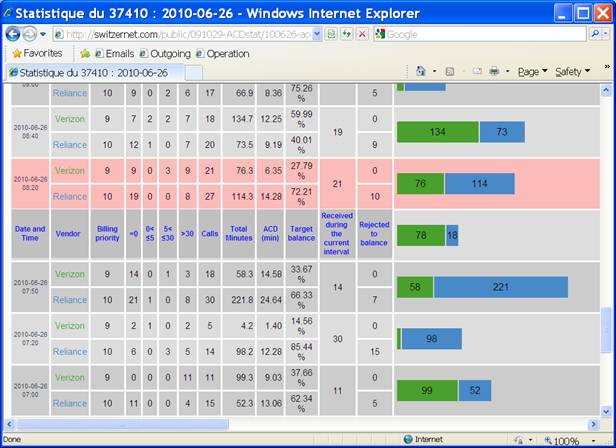
The ACD statistics show that Reliance offers ACD values longer than 10 minutes (see the minutes on the screenshot 9.19, 14.28, 24.64, 12.28, and 13.06):
[html]
With this scenario we do not know what would happen with the re-INVITE of Reliance, if it is received and retransmitted. In the next scenario, we generate local replies if the sending party is one of our PortaSIP nodes.
2010-06-27 16:03, Relaying all except the re-invites of our own portasip servers
This section presents another configuration, which does not relay the re-invites of our own servers, but relays the re-invites of Reliance. The configuration is validated on SIP packet exchanges. The packets are logged using ngrep:
# ngrep -pql -t -W byline "" host 220.224.129.21 and port 5060 > `date +%y%m%d.%H%M%S`.ngrep.log.txt
A portion of file containing a long call is taken. The packets are retrieved into individual files:
$ i=1000; cat 100627.160243.call-sample.txt | while read s; do echo $s | grep -q "^U " && i=$((i+1)); echo $s >> $i.txt; done
$ u2d 1???.txt
Only packets concerning the call are kept:
$ for f in 1???.txt; do grep -q 37410546747 $f && echo $f; done
1001.txt
1002.txt
1005.txt
1009.txt
. . .
$ for f in 1???.txt; do grep -q 37410546747 $f || rm $f; done
$ i=2000; for f in 1???.txt; do mv $f $i.txt; i=$((i+1)); done
[log]
Below is a diagram of the call that lasts 29 minutes.
|
Protocol, Date, Time, From, and To |
87. 106. 166. 145: 5060 |
The digest of the SIP message. The full message is under the link. |
220. 224. 129. 21: 5060 |
Comments |
|
U 2010/06/27 18:46:20.442289 87.106.166.145:5060 -> 220.224.129.21:5060
|
>>> |
INVITE sip:37410546747@220.224.129.21:5060 SIP/2.0. From: <sip:18182557014@66.234.138.73> To: <sip:37410546747@87.106.166.145>. [sip] |
|
|
|
U 2010/06/27 18:46:20.727585 220.224.129.21:5060 -> 87.106.166.145:5060
|
|
SIP/2.0 100 Trying. From: <sip:18182557014@66.234.138.73> To: <sip:37410546747@87.106.166.145>. [sip] |
<<< |
|
|
U 2010/06/27 18:46:38.236142 220.224.129.21:5060 -> 87.106.166.145:5060
|
|
SIP/2.0 183 Session Progress. From: <sip:18182557014@66.234.138.73> To: <sip:37410546747@87.106.166.145> [sip] |
<<< |
PDD is of 18 sec. |
|
U 2010/06/27 18:47:02.125932 220.224.129.21:5060 -> 87.106.166.145:5060
|
|
SIP/2.0 200 OK. From: <sip:18182557014@66.234.138.73> To: <sip:37410546747@87.106.166.145> [sip] |
<<< |
Ringing 24 seconds |
|
U 2010/06/27 18:47:02.297495 87.106.166.145:5060 -> 220.224.129.21:5060
|
>>> |
ACK sip:37410546747@220.224.129.21:5060 SIP/2.0. From: <sip:18182557014@66.234.138.73> To: <sip:37410546747@87.106.166.145> [sip] |
|
|
|
U 2010/06/27 18:52:02.128243 220.224.129.21:5060 -> 87.106.166.145:5060
|
|
INVITE sip:66.234.138.73:5061 SIP/2.0. From: <sip:37410546747@87.106.166.145> To: <sip:18182557014@66.234.138.73> [sip] |
<<< |
Ping fro Reliance after 5 min |
|
U 2010/06/27 18:52:02.128342 87.106.166.145:5060 -> 220.224.129.21:5060
|
>>> |
SIP/2.0 100 Giving a try. From: <sip:37410546747@87.106.166.145> To: <sip:18182557014@66.234.138.73> [sip] |
|
Relaying |
|
U 2010/06/27 18:52:02.299960 87.106.166.145:5060 -> 220.224.129.21:5060
|
>>> |
SIP/2.0 200 OK. From: <sip:37410546747@87.106.166.145> To: <sip:18182557014@66.234.138.73> [sip] |
|
|
|
U 2010/06/27 18:52:02.590446 220.224.129.21:5060 -> 87.106.166.145:5060
|
|
ACK sip:66.234.138.73:5061 SIP/2.0. From: <sip:37410546747@87.106.166.145> To: <sip:18182557014@66.234.138.73> [sip] |
<<< |
|
|
U 2010/06/27 18:57:02.594364 220.224.129.21:5060 -> 87.106.166.145:5060
|
|
INVITE sip:66.234.138.73:5061 SIP/2.0. From: <sip:37410546747@87.106.166.145> To: <sip:18182557014@66.234.138.73> [sip] |
<<< |
Ping after another 5 min |
|
U 2010/06/27 18:57:02.594475 87.106.166.145:5060 -> 220.224.129.21:5060
|
>>> |
SIP/2.0 100 Giving a try. From: <sip:37410546747@87.106.166.145> To: <sip:18182557014@66.234.138.73> [sip] |
|
Relay |
|
U 2010/06/27 18:57:02.766434 87.106.166.145:5060 -> 220.224.129.21:5060
|
>>> |
SIP/2.0 200 OK. From: <sip:37410546747@87.106.166.145> To: <sip:18182557014@66.234.138.73> [sip] |
|
|
|
U 2010/06/27 18:57:03.057106 220.224.129.21:5060 -> 87.106.166.145:5060
|
|
ACK sip:66.234.138.73:5061 SIP/2.0. From: <sip:37410546747@87.106.166.145> To: <sip:18182557014@66.234.138.73> [sip] |
<<< |
|
|
U 2010/06/27 19:02:03.062167 220.224.129.21:5060 -> 87.106.166.145:5060
|
|
INVITE sip:66.234.138.73:5061 SIP/2.0. From: <sip:37410546747@87.106.166.145> To: <sip:18182557014@66.234.138.73> [sip] |
<<< |
3rd ping after 5 min interval |
|
U 2010/06/27 19:02:03.062255 87.106.166.145:5060 -> 220.224.129.21:5060
|
>>> |
SIP/2.0 100 Giving a try. From: <sip:37410546747@87.106.166.145> To: <sip:18182557014@66.234.138.73> [sip] |
|
Relaying |
|
U 2010/06/27 19:02:03.239645 87.106.166.145:5060 -> 220.224.129.21:5060
|
>>> |
SIP/2.0 200 OK. From: <sip:37410546747@87.106.166.145> To: <sip:18182557014@66.234.138.73> [sip] |
|
|
|
U 2010/06/27 19:02:03.529045 220.224.129.21:5060 -> 87.106.166.145:5060
|
|
ACK sip:66.234.138.73:5061 SIP/2.0. From: <sip:37410546747@87.106.166.145> To: <sip:18182557014@66.234.138.73> [sip] |
<<< |
|
|
U 2010/06/27 19:07:03.532265 220.224.129.21:5060 -> 87.106.166.145:5060
|
|
INVITE sip:66.234.138.73:5061 SIP/2.0. From: <sip:37410546747@87.106.166.145> To: <sip:18182557014@66.234.138.73> [sip] |
<<< |
4th ping after 5 min delay |
|
U 2010/06/27 19:07:03.532366 87.106.166.145:5060 -> 220.224.129.21:5060
|
>>> |
SIP/2.0 100 Giving a try. From: <sip:37410546747@87.106.166.145> To: <sip:18182557014@66.234.138.73> [sip] |
|
Relaying |
|
U 2010/06/27 19:07:03.704416 87.106.166.145:5060 -> 220.224.129.21:5060
|
>>> |
SIP/2.0 200 OK. From: <sip:37410546747@87.106.166.145> To: <sip:18182557014@66.234.138.73> [sip] |
|
|
|
U 2010/06/27 19:07:03.994421 220.224.129.21:5060 -> 87.106.166.145:5060
|
|
ACK sip:66.234.138.73:5061 SIP/2.0. From: <sip:37410546747@87.106.166.145> To: <sip:18182557014@66.234.138.73> [sip] |
<<< |
|
|
U 2010/06/27 19:12:04.010847 220.224.129.21:5060 -> 87.106.166.145:5060
|
|
INVITE sip:66.234.138.73:5061 SIP/2.0. From: <sip:37410546747@87.106.166.145> To: <sip:18182557014@66.234.138.73> [sip] |
<<< |
5th ping |
|
U 2010/06/27 19:12:04.011158 87.106.166.145:5060 -> 220.224.129.21:5060
|
>>> |
SIP/2.0 100 Giving a try. From: <sip:37410546747@87.106.166.145> To: <sip:18182557014@66.234.138.73> [sip] |
|
|
|
U 2010/06/27 19:12:04.183303 87.106.166.145:5060 -> 220.224.129.21:5060
|
>>> |
SIP/2.0 200 OK. From: <sip:37410546747@87.106.166.145> To: <sip:18182557014@66.234.138.73> [sip] |
|
|
|
U 2010/06/27 19:12:04.472415 220.224.129.21:5060 -> 87.106.166.145:5060
|
|
ACK sip:66.234.138.73:5061 SIP/2.0. From: <sip:37410546747@87.106.166.145> To: <sip:18182557014@66.234.138.73> [sip] |
<<< |
|
|
U 2010/06/27 19:15:48.677910 220.224.129.21:5060 -> 87.106.166.145:5060
|
|
BYE sip:66.234.138.73:5061 SIP/2.0. From: <sip:37410546747@87.106.166.145> To: <sip:18182557014@66.234.138.73> [sip] |
<<< |
Bye from the called party |
|
U 2010/06/27 19:15:48.848817 87.106.166.145:5060 -> 220.224.129.21:5060
|
>>> |
SIP/2.0 200 OK. From: <sip:37410546747@87.106.166.145> To: <sip:18182557014@66.234.138.73> [sip] |
|
|
[log]
The current configuration file now generates the replies to re-invites locally only if the request is sent from one of our porta-sip servers. Otherwise the requests are retransmitted.
route{
if (has_totag())
{
if (loose_route())
{
if( method=="INVITE" && ($si=="91.121.66.202" || $si=="91.121.19.149" || $si=="91.121.101.126" || $si=="91.121.75.124" || $si=="91.121.167.75" || $si=="91.121.70.119" || $si=="91.121.138.5" || $si=="91.121.99.16" || $si=="82.103.128.3" || $si=="66.234.138.73" || $si=="94.23.225.212" || $si=="94.23.242.200" || $si=="213.251.169.218") )
{
if(t_newtran())
{
t_reply("100","Your Re-INVITE is received");
t_reply("488","Your Re-INVITE is ignored");
exit;
}
else
{
sl_send_reply("100","Your Re-INVITE is received (SL)");
sl_send_reply("488","Your Re-INVITE is ignored (SL)");
exit;
}
}
t_relay();
exit;
}
exit;
}
if ($si!="91.121.66.202" and $si!="91.121.19.149" and $si!="91.121.101.126" and $si!="91.121.75.124" and $si!="91.121.167.75" and $si!="91.121.70.119" and $si!="66.234.138.73" and $si!="82.103.128.3" and $si!="217.168.45.4" and $si!="212.249.15.3" and $si!="212.249.15.9" and $si!="91.121.138.5" and $si!="94.23.225.212" and $si!="94.23.242.200" and $si!="213.251.169.218" and $si!="91.121.99.16")
{
sl_send_reply("403","Forbidden here xx");
exit;
}
if(is_method("INVITE"))
{
record_route();
}
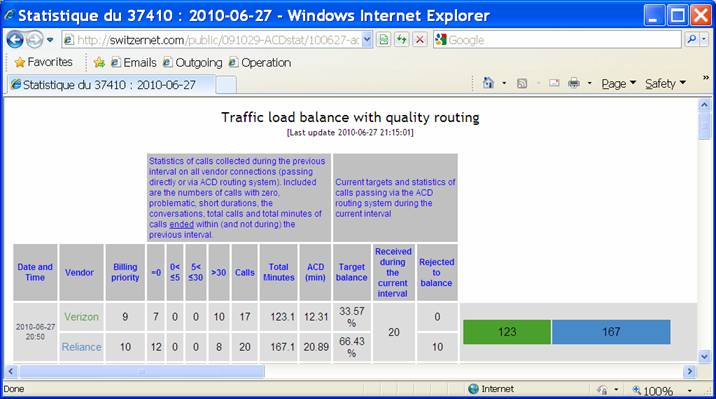
The ACD routing stats also confirm that we do not have the problem of systematic call interruptions.
[html]
* * *

Copyright © 2010 by Switzernet